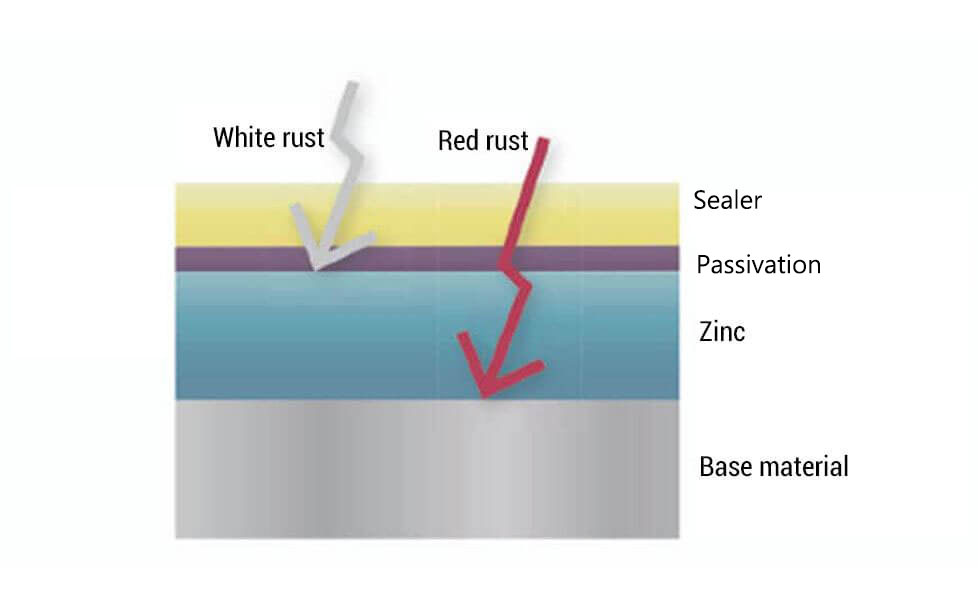
The corrosion resistance of fasteners depends on a multi-layer composite coating structure. Triple protection provided by the zinc layer, passivation layer, and sealer effectively delays the oxidation of the base material (carbon steel).
Structure | Thickness (μm) | Main Function | Rust Determination |
Sealer | 0.2–2 μm | Outermost protection layer that fills micropores and enhances salt spray corrosion resistance. | — |
Passivation | 0.05–0.8 μm | Forms a dense chemical film through chemical reaction, effectively slowing down the oxidation rate of the zinc layer. | — |
Zinc | 7–8 μm | Serves as a sacrificial protective layer. Being higher in metal activity than iron, it oxidizes first to protect the base material. | White Rust: Occurs when environmental corrosion reaches the zinc layer. |
Base Material | — | The carbon steel or iron body of the screw. | Red Rust: Occurs when the zinc layer is completely depleted and the substrate begins to oxidize and rust. |