How to evaluate the lifespan of screws?
In the fastener and screw manufacturing industry, the Salt Spray Test (SST) is the most core international standard for evaluating the anti-corrosion performance of metal product surface treatments. Many procurement professionals and engineers often ask: “How many hours of salt spray testing do my screws need to withstand?” and “What is the difference between white rust and red rust?” This article will provide a data-driven analysis of accelerated corrosion environments to help you accurately evaluate the service life of screws in harsh environments.
What are the core classifications and international standards for salt spray testing?
- Salt spray test standard specification: ASTM B117
- Test conditions: 5% NaCl aqueous solution, pH value controlled at 6.5–7.2, test chamber temperature 35°C.
How to determine the test results?
In fastener quality assurance inspection, the protection time of the salt spray test is usually based on “hours” and the “appearance of corrosion products” as acceptance criteria:
Rust Type | Definition & Characteristics | Material Affected | Indication / Impact | Role in Testing |
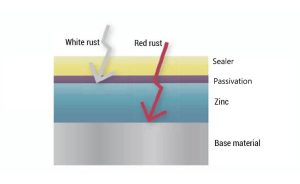
White Rust | White powdery corrosion product generated when oxidation begins. | The coating itself (e.g., zinc layer). | Indicates that the protective layer has started to deplete, but the screw substrate is not yet damaged. | Serves as an early indicator of coating consumption. |
Red Rust | Standard iron rust produced when metal comes into direct contact with the environment. | The substrate metal (e.g., carbon steel, alloy steel). | Indicates that the protective coating is completely exhausted and the base metal is corroding. | Typically defined as the final determination point of the fastener’s protection lifespan (“hours to red rust”). |
Can salt spray test hours be directly converted into the service life in actual environments?
The salt spray test is an “Accelerated Test,” conducted in an environment with constant temperature, constant humidity, and continuous spraying. In actual natural environments, factors such as wet-dry cycles, UV radiation, acid rain, and stress fatigue exist; therefore, salt spray test hours cannot be directly and linearly converted into actual service life using a fixed ratio (for example: 100 hours equals 1 year). The core value of SST lies in verifying process stability and comparing the relative anti-corrosion performance of different surface treatments.
Note: The data listed in this table are reference values; the actual corrosion resistance performance should be based on actual test conditions.
Time Unit | Coastal Days | Natural Exposure Days | Surface Treatment Method |
1 hour | 5 days | 15 days | |
5 hours | 25 days | 75 days | Black oxide |
15 hours | 75 days | 225 days | Standard Nickel Plating / Chrome Plating / Black Zinc |
20 hours | 100 days | 300 days | Standard Zinc Plating / Yellow Zinc (Zinc Chromate) |
24 hours | 120 days | 1 year | Through chemical conversion coating (film treatment), Zinc Plating / Yellow Zinc / Black Zinc—these three can withstand salt spray up to a maximum of 96 hours. |
48 hours | 240 days | 2 years | |
72 hours | 360 days | 3 years | |
96 hours | 480 days | 4 years | |
500 hours | 2500 days | 20 years | Dacromet / Ruspert |