Common Self-Tapping Thread Types
Type | Core Features | Best Application Scenarios | Pre-drilling Requirement |
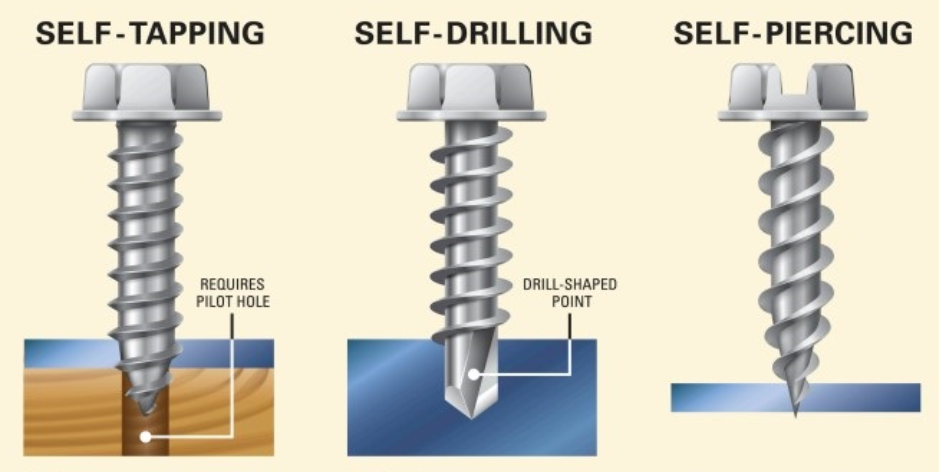
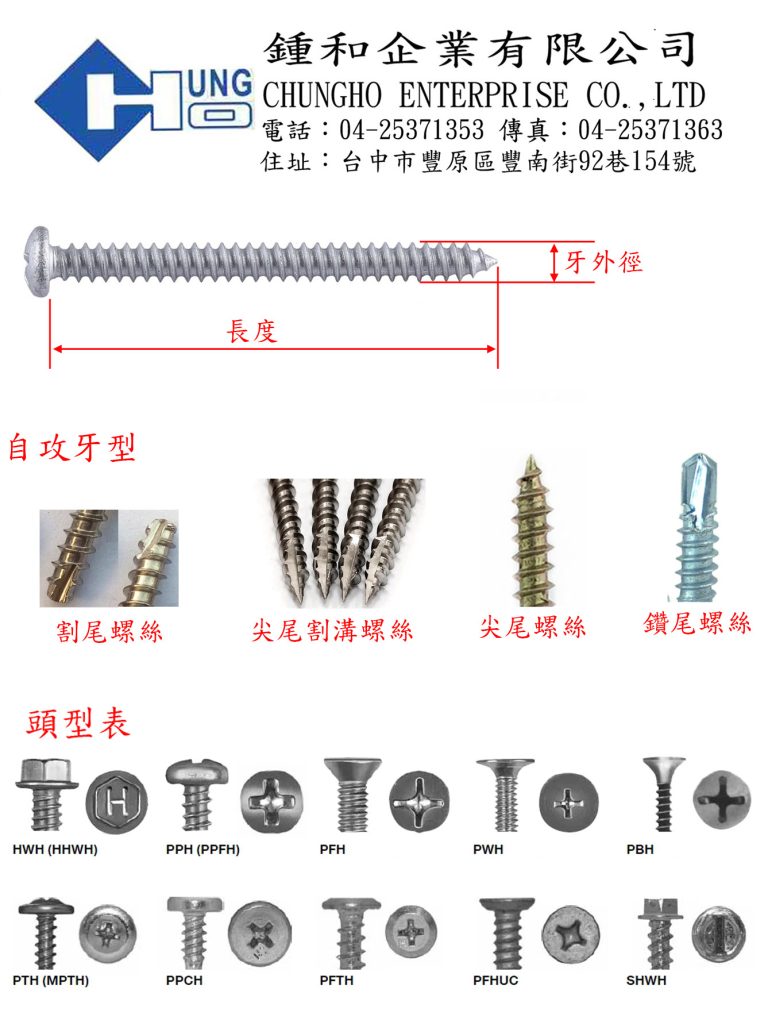
Sharp Point Screw (Type A/AB) | Directly forms threads by tightly compressing the base material. | Wood assembly, soft plastics, thin metal sheets | Usually requires a pre-drilled hole |
Thread-Cutting Screw (Type F/BT) | Features a chip-removal groove at the tail with cutting functionality. | Hard plastics, thicker metals, die-cast parts | Requires a pre-drilled hole |
Gash Point Screw | Combines a sharp point with a cutting groove to reduce insertion torque. | Medium-hardness wood, composite materials, plastics | Depends on the material |
Self-Drilling Screw (Tek Screw) | Integrates a drill-bit tip; performs drilling, tapping, and fastening in one step. | Steel structure engineering, thick sheet metal, corrugated roofing sheet installation | Completely eliminates the need for pre-drilling |
Common Head Types Chart
In addition to the point type, the head type determines the surface flushness after installation as well as the driving tool required:
- HWH (Hex Washer Head): Features a large bearing surface, making it ideal for heavy-duty industrial applications and structural steel framing that require high tightening torque.
- PPH (Pan Phillips Head): Has a rounded head profile that sits above the surface. It is the most versatile and visually clean choice for electronics and mechanical enclosures.
- PFH (Flat Phillips Head / Countersunk Head): Sinks completely flush with the base material surface, suitable for applications requiring a flat finish or where secondary components overlap.
- PWH (Pan Washer Head): Increases the bearing area to prevent soft materials (such as plastics or thin sheets) from deforming or tearing through during tightening.
- PTH (Pan Torx Head): Paired with a Torx drive, it delivers significantly higher torque transmission than a Phillips drive, effectively preventing cam-out and stripping.
Other Special Head Types: Includes PBH, PPCH, PFTH, PFHUC, SHWH, etc., which can be selected based on specific mechanical drawing specifications.
How Thick Can a Self-Drilling Screw Penetrate Steel Plate?
Point No. | Applicable Steel Thickness Range | Common Application Scenarios |
#2 Point | 1.6 mm – 3.0 mm | Light gauge steel framing, thin sheet metal, light C-purlins |
#3 Point (Most Common) | 2.5 mm – 4.5 mm | Standard C-purlins, standard sheet-metal roofing structures |
#4 Point | 4.0 mm – 6.0 mm | Heavy C-purlins, small H-beams, medium structural steel |
#5 Point (Heavy-Duty Drill Point) | 6.0 mm – 12.0 mm | Heavy H-beams, thick steel plate construction |
👉 Join the discussion on Facebook: